
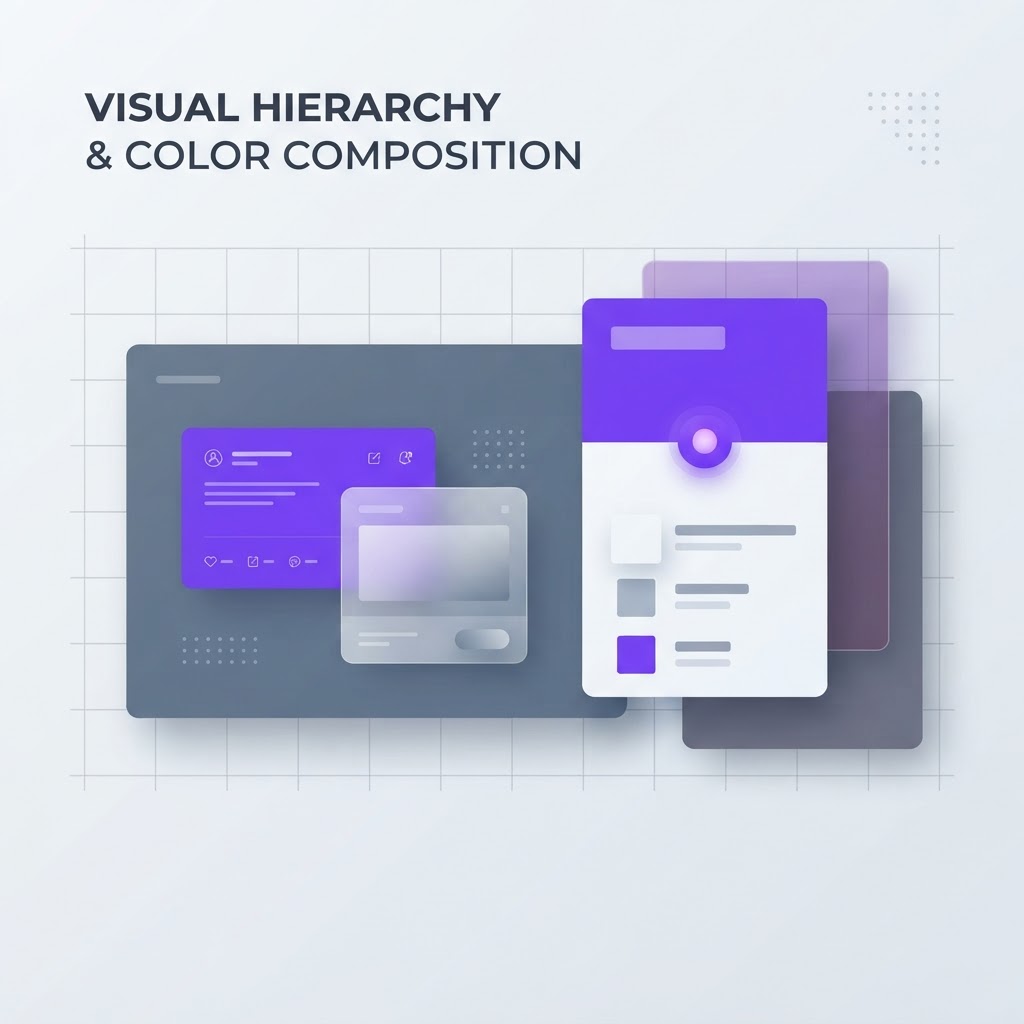
Mastering Visual Hierarchy and Color Rules in Modern UI Design
Originally shared as a carousel on @dailywebdesign, original carousel by @lubosvolkov.
Mastering Visual Hierarchy and Color Rules in Modern UI Design
Visual hierarchy is the foundation of every great interface. Senior designer Lubos Volkov breaks down the essential rules that separate amateur designs from professional ones.

The Fundamentals of Visual Hierarchy
Visual hierarchy guides the user's eye through your interface. Every element competes for attention, hierarchy determines the winner.
Size and Scale
Larger elements demand attention first. Use size strategically: your primary headline should be 2-3x larger than body text.
Color and Contrast
High contrast draws the eye. Use your brand's primary color for CTAs and critical actions. Neutral palettes for content areas.
Spacing and Proximity
Whitespace is a design element, not empty space. Group related items together and separate distinct sections with generous padding.

Color Rules That Work
- Never use pure black (#000), use dark grays like #1a1a1a
- Limit your palette to 3-4 colors maximum
- Use the 60-30-10 rule: 60% dominant, 30% secondary, 10% accent
- Test color combinations for accessibility (WCAG AA minimum)

Practical Implementation in Figma
Create design tokens for your color system. Use variables for spacing, typography, and color to ensure consistency across your entire product.

Ready to level up your design skills? Take the NewForm quiz to find your perfect design tools.
View the full carousel on Instagram →
Originally shared as a carousel on @dailywebdesign, original carousel by @lubosvolkov.
Find Your Stack
Discover the perfect design tools for your workflow.
Take the 60-second quizNewForm Studio
Turn your designs into professional mockups instantly.
Open StudioMore from NewForm

Before and After UI Redesign: What Actually Changes When You Level Up a Design
A before and after UI redesign reveals the difference between decent and great design. Here is what changes and the principles that drive the improvement.
5 min read · Oct 3, 2026

Graphic Design Trends Every Designer Should Try in 2026
From 3D depth to bold typography and AI-assisted design systems, the 2026 graphic design trends are reshaping how designers create. Here is what to try now.
5 min read · Oct 3, 2026