
Vibe Code Brief, October 10: ChatGPT Starts Generating Interactive UI
Today is October 10, 2026. The big story is OpenAI putting GPT-6 with Intelligent UI in front of every ChatGPT user, turning chat responses into interactive software. Plus: GPT-6.1 Sol cuts API costs for builders, Meta launches Muse to top the App Store, and Verizon goes all in on vibe coding for non-developers.
1. OpenAI Rolls Out GPT-6 With Intelligent UI to All ChatGPT Users
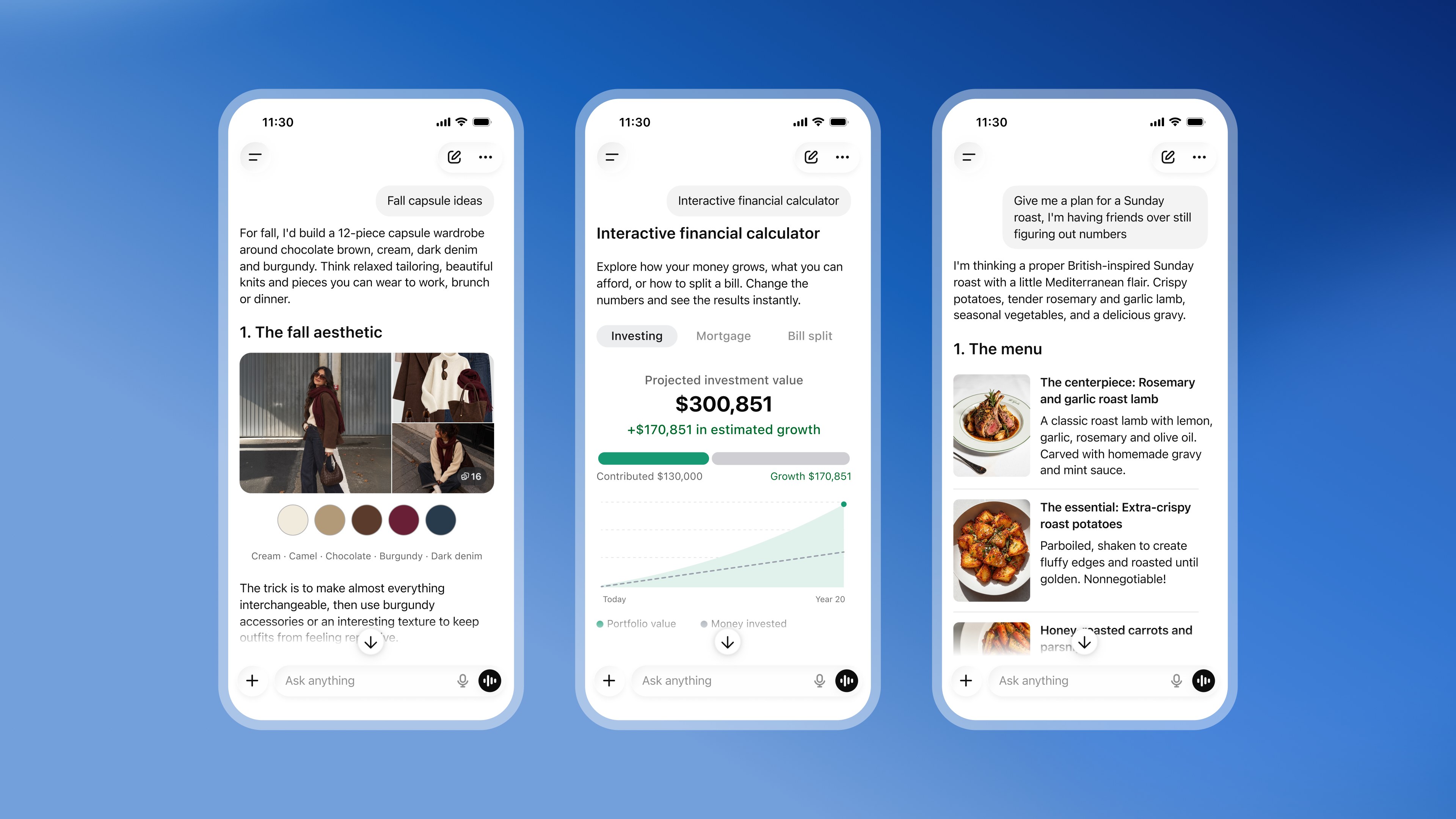 Image: OpenAI, via GPT-6 and Intelligent UI for everyone
What happened: On October 7, OpenAI started rolling out GPT-6 with Intelligent UI to ChatGPT Plus, Pro, Business, and Enterprise users. The next day, it reached Free and Go tiers. Intelligent UI lets ChatGPT generate interactive charts, forms, tappable buttons, diagrams, mini-games, and calculators directly inside responses. The Verge and Wired both covered the launch.
Why it matters to designers and builders: OpenAI trained GPT-6 to make design decisions about layout, content organization, and when to use interactivity versus text. They built a component library and a compiler for rendering interfaces. That is a design system powered by AI, and it is in front of a billion people.
What to do: Open ChatGPT and ask it to create an interactive tool or diagram. Study what it gets right and where it fails. Those gaps are where your skills matter most.
2. GPT-6.1 Sol Arrives in the API at a Fraction of the Cost
 Image: OpenAI, via The Next Web
What happened: OpenAI released GPT-6.1 Sol in the API on October 8, priced at $2 per million input tokens and $10 per million output tokens. The model costs roughly $5.47 per completed task on average, compared with $23.21 for Anthropic's Claude Opus 5.5 and $23.80 for GPT-6 Astra. Cached input dropped from $0.20 to $0.10 per million tokens. The Next Web reported it as a fifth of Astra's cost.
Why it matters to designers and builders: If you are building AI-powered apps, API costs are your biggest constraint. GPT-6.1 Sol delivering 75.2% on FrontierCode at high effort, while costing 75% less per task than top-tier models, changes the math for production AI features. Your prototypes can become products without the bill killing you.
What to do: Compare GPT-6.1 Sol against your current model for coding tasks. The cost savings on repetitive agent work could be significant.
3. Meta Launches Muse AI Agent, Tops the App Store
 Image: Meta, via AI at Meta
What happened: Meta launched Muse, its personal AI agent app, after months of delay over safety concerns. The New York Times reported on October 9 that Mark Zuckerberg accelerated the launch after competition from Instinct and OpenAI's Dots intensified. Muse quickly topped the App Store.
Why it matters to designers and builders: AI agents are now consumer products competing for App Store dominance. If you are building AI tools, the bar for user experience just went up. Meta, OpenAI, and Instinct are all fighting for the same users, and design quality will be a differentiator.
What to do: Download Muse and compare its UX to ChatGPT and Instinct. Watch how each handles task delegation, notifications, and onboarding. That is your competitive landscape now.
4. Verizon Says You Do Not Need to Be a Developer to Vibe Code
 Image: Verizon, via CSRWire
What happened: Verizon published a press release on October 8 declaring that "you don't have to be a developer to benefit from vibe coding." The company positions natural-language app building as a mainstream productivity tool, not a niche for engineers.
Why it matters to designers and builders: When a Fortune 500 telecom starts telling its customers that anyone can build apps with AI, vibe coding has crossed from trend to mainstream. Your audience is expanding. The people who need design help and app-building tools are no longer just developers.
What to do: If you create content, tools, or courses for builders, start speaking to non-developers too. The market just got bigger.
Our Take
This week, AI stopped being something you chat with and started being something you use. GPT-6's Intelligent UI puts interactive software inside a conversation. GPT-6.1 Sol makes it cheap enough to ship. Muse proves consumers want AI agents, not just chatbots. And Verizon confirms the audience for all of this is everyone, not just developers. The tools are getting better, cheaper, and more accessible. Your job is to figure out what to build with them.
Building something from today's news? Start with Base44, the AI app builder I rank number one. Want to practice on smaller projects? Try our Daily Vibe Code challenges.
Find Your Stack
Discover the perfect design tools for your workflow.
Take the 60-second quizNewForm Studio
Turn your designs into professional mockups instantly.
Open StudioMore from NewForm
Vibe Code Brief, October 9: AI Rebuilds Adobe Creative Cloud for Free
Four stories for designers and builders: ArtCraft vibe-coded seven Adobe apps for free, Anthropic slashed Claude Haiku 5.5 prices by 90%, Google opened its SynthID Detector to the public, and vibe-coded apps are becoming an enterprise security problem.
5 min read · Oct 9, 2026

Vibe Code Brief, October 8: Google opens the game-making door
Google Playground, Unity Spark, and Dropbox’s AI adoption approach point to a common lesson: faster first drafts make testing and judgment more important.
4 min read · Oct 8, 2026