Vibe Code Brief, October 19: Antigravity 2 Ditches the IDE Entirely
The theme of today's brief: the tool is dissolving into conversation, the production gap just became a fundable business, and free models keep eating the budget tier. Five items, all from the last 72 hours, all worth a builder's attention.
1. Google Antigravity 2.0: no code editor, just agent chat

Image: Google, via Introducing Google Antigravity 2.0.
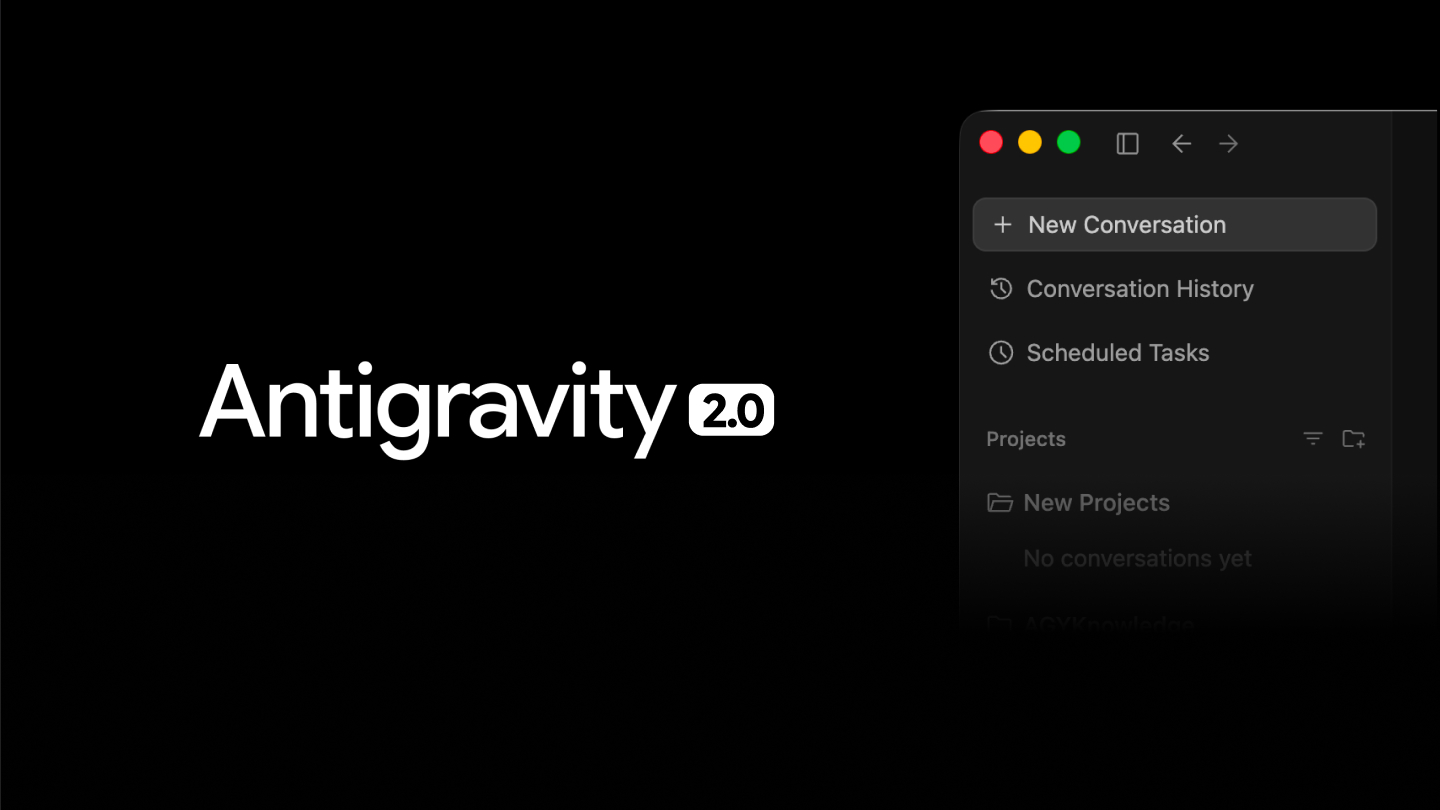
What happened: Google's Antigravity 2.0 announcement describes a standalone desktop "command center" for agents, and InfoWorld's hands-on confirms the direction: a chat-centric app with no code editor at all. Workspaces became projects with explicit directories, permissions and settings. Agents run in local mode (editing your folders directly) or worktree mode (a fresh Git worktree per conversation so parallel subagents cannot stomp each other). Slash commands like /btw and /grill-me let you steer mid-task.
Why it matters to designers and builders: the interface you design with is dissolving into conversation. For the non-developers in our community, chat was always the whole product anyway, and now Google ships it that way on purpose. Worktree mode is the quiet headline: guardrails and isolation are moving into chat tools, which is exactly what makes agent-built client work defensible.
What to do: try it if you are agent-first. If you still live in code, the Antigravity IDE remains available alongside it.
2. A vibe-coded site was hacked 6 days after launch
What happened: a South African business built its site with a free AI tool, and attackers read the admin password out of the shipped code, in plain text, six days after launch (MyBroadband, iAfrica). Security folks quoted in the coverage say attackers scan for AI-tool fingerprints within hours of a site going live.
Why it matters to designers and builders: the model was fine and the site looked fine. What failed was the launch checklist nobody ran. When a website required a developer, the boring rituals came bundled. Vibe coding unbundled them, and did not tell you.
What to do: read the full deep dive with the 30-minute pre-launch checklist I wrote on this today: A Vibe-Coded Site Got Hacked 6 Days After Launch. Run it on every launch, and put the checklist in your client proposals.
3. Anthropic commits at least 5% of its shares to a public-benefit fund

Image: Anthropic, via Anthropic news.
What happened: Anthropic announced a company-owned public-benefit fund that will receive at least 5% of its shares, subject to stockholder approval, to support causes like addressing AI-driven disruption (The Information, OpenTools analysis). Counting earlier founder and employee pledge commitments, the company points to roughly 20% of shares supporting public-benefit purposes. Governance details are still open questions.
Why it matters to designers and builders: if you are building a business on Claude, and many of us are, the stewardship of the company behind your stack is part of your due diligence. Equity commitments ahead of a widely expected IPO signal which way the trust levers are pointing.
What to do: watch the governance follow-through more than the announcement. This belongs in your platform-risk notes, not your pitch decks.
4. RapidCanvas raised $29M to close vibe coding's production gap

Image: RapidCanvas, via rapidcanvas.ai.
What happened: RapidCanvas raised a $29M Series B led by Vertex Ventures SEA & India, with Hitachi Ventures, Accel, Peak XV Partners and others (SiliconANGLE). The company builds custom AI applications for mid-market enterprises across 75+ clients, says its automation platform handles about 60% of the usual build work, and reports revenue grew eightfold in 18 months.
Why it matters to designers and builders: the CEO's quote is the whole story: "Vibe coding has made it easy to start building with AI. Getting AI into production reliably and safely still remains the biggest gap." A product mindset plus reliability tooling is exactly the service layer freelancers and small studios can sell right now, without a $29M raise.
What to do: steal the positioning. Sell the launch checklist, the reliability pass and the maintenance contract, not just the pretty demo. The money is in the gap.
5. DeepSeek shipped V4.1-Flash-1017, free, fast and MIT licensed

Image: DeepSeek, via deepseek.com.
What happened: DeepSeek released V4.1-Flash-1017 on October 17, a faster, leaner update to its flash-tier model, after recent service disruptions (SiliconANGLE). Early numbers reported by MarkTechPost include a 77.0 score on DeepSWE, strong human-eval results, and a newly opened Search API. The model is free to use and MIT licensed.
Why it matters to designers and builders: your model bill is a design constraint. Free, open-weight, quick models are the budget tier of every agent stack, and they keep getting better. Open weights mean you can self-host, which matters for client work with data restrictions (see item 2 for why launch trust is suddenly the whole conversation).
What to do: add it to your eval candidates if you wire your own agents. Peek at the Search API if retrieval is part of your builds.
Our take
The IDE is officially optional now. Between Antigravity stripping out the editor, RapidCanvas raising $29M to make AI-built things survive production, and a site getting popped in 6 days over a plain-text password, today's news is one story wearing five outfits: generation is nearly free, and everything that is not generation, judgment, checklists, reliability, taste, is the product. That is good news for designers specifically, since taste is the one input the models keep asking us for. Build like the checklist is yours, because it is.
Building something from today's news? Start with the builder we rank #1 for shipping real apps: Base44. Want deliberate practice instead? Try today's prompt: Daily Vibe Code.
Related on NewForm
Keep reading

Find Your Stack
Discover the perfect design tools for your workflow.
Take the 60-second quizNewForm Studio
Turn your designs into professional mockups instantly.
Open StudioMore from NewForm

Vibe Code Brief, November 2: Antigravity Inherits Jules's Cloud Execution
Google is folding Jules's cloud runs into Antigravity, Meituan shipped a coding model built for long agent sessions, itch.io's page flood shows supply without demand, and ADNOC became the first energy company in OpenAI's Frontier program.
5 min read · Nov 2, 2026

Vibe Code Brief, November 1: Nine AI Platforms Breached in One Month
Nine AI platforms disclosed breaches in one October month, an Xbox manager deleted his AI admission, and New York set the first companion chatbot rules for minors.
4 min read · Nov 1, 2026