
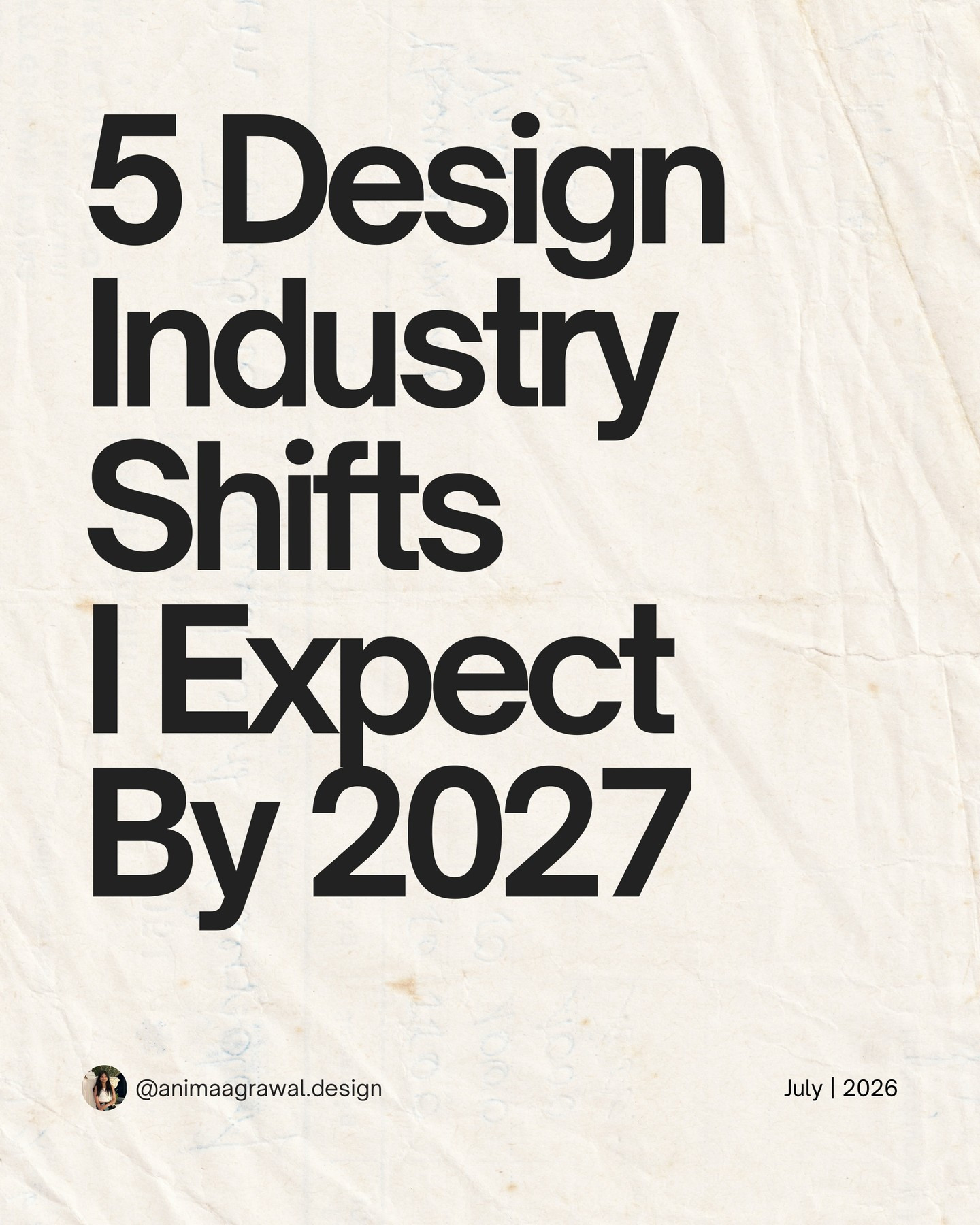
5 Ways AI Is Changing the Future of Design
5 Ways AI Is Changing the Future of Design
Artificial intelligence is making production faster, but speed is only one part of the story. A thoughtful carousel from @animaagrawal.design argues that the future of design will be shaped less by who can produce the most pixels and more by who can bring original ideas, make strong decisions, and direct technology well.

These predictions are useful because they frame AI as a change in where value lives, not as a simple replacement for the design process.
1. Original thinking becomes a premium skill

AI can generate options, but it does not automatically know which problem is worth solving or why a particular idea matters. As generated imagery, layouts, copy, and concepts become easier to produce, genuinely original thinking will become easier to recognize, and more valuable.
For designers, this means spending more time understanding the audience, finding a sharp point of view, and connecting ideas in ways that are not obvious. A prompt can produce ten visual directions, but the designer still needs to decide what the work should say, who it should serve, and what makes it different. Research, observation, and cultural awareness become creative advantages.
2. Designers will edit AI output

The job is moving from manually creating every detail to improving, correcting, and directing what AI generates. That does not make craft irrelevant. It makes judgment more visible. Designers need to spot weak hierarchy, awkward language, inconsistent spacing, accessibility problems, and visual decisions that technically work but feel wrong.
Editing AI output is also a form of authorship. The final result depends on the brief, the constraints, the references, the iterations, and the decisions made after generation. Designers who can articulate why something should change will be more effective than those who simply accept the first plausible result.
3. Smaller teams gain more power
AI gives lean studios and small product teams access to capabilities that once required larger agencies, specialized departments, or bigger budgets. A small team can explore more concepts, produce more content variations, and test ideas earlier in the process.
The advantage is not just lower cost. Small teams can move with less coordination overhead. But this also raises the standard for clarity: when fewer people are involved, everyone needs to understand the goal, the audience, and the definition of quality. AI can multiply output, but only a coherent direction keeps that output useful.
4. Businesses pay more for strong decisions

The value of design is expanding beyond visuals. Strategy, taste, and human judgment become increasingly important when production is abundant. Businesses will want people who can identify the right opportunity, prioritize tradeoffs, and explain why one direction is more likely to work.
This is a shift from presenting design as decoration to presenting it as decision-making. Strong designers connect an interface to a user need and a business outcome. They can defend a choice, revise it when evidence changes, and keep the team focused when there are too many possible directions.
5. Ideas become the new creative value

Making things is getting easier every day. Knowing what is worth making, and why, is where the real skill increasingly lives. This makes problem framing, concept development, and editorial judgment central parts of modern design practice.
The practical response is to build a stronger idea habit. Keep a swipe file, write down recurring user frustrations, study adjacent industries, and practice describing the core idea behind a design in one sentence. Better concepts give AI better direction and give teams a clearer way to evaluate the results.
From production to judgment

The final takeaway is a useful shorthand: design is moving from execution to direction, production to judgment, and output to ideas. AI does not remove the need for designers; it changes which designer strengths are hardest to replace.
The best way to prepare is not to chase every new tool. Learn to brief clearly, evaluate critically, protect human perspective, and connect design choices to real outcomes. Then use AI where it genuinely improves the work.
Explore faster ways to turn ideas into working products with Base44.
,
This article was inspired by the original carousel from @animaagrawal.design. Read the original Instagram post and save it for later.
,
Credit: @animaagrawal.design
What designers can practice today
These changes point toward a practical development plan. Practice writing clearer briefs, because better instructions produce better first passes. Practice critique, because generated work still needs a sharp eye. Practice presenting the reasoning behind a direction, because stakeholders increasingly need confidence in the decision, not just another visual option.
It is also worth keeping a record of your contributions. Save early concepts, rejected directions, research notes, and the decisions that shaped the final work. In an AI-assisted process, the visible output may look easy to produce, but the thinking that framed and refined it is still the part that demonstrates your value.
Related on NewForm

FREE FIELD GUIDE
The 8-Prompt Product
Answer 24 questions, run 8 prompts, and walk away this afternoon with a working, beautiful MVP you would be proud to show.
See what's insideKeep reading
Find Your Stack
Discover the perfect design tools for your workflow.
Take the 60-second quizNewForm Studio
Turn your designs into professional mockups instantly.
Open StudioMore from NewForm
Best AI App Builders for Designers in 2026: What to Choose for Real UI Work
Compare Base44, Lovable, Bolt, v0, Replit and Framer for design fidelity, control, real app behavior and pricing. A transparent evaluation guide for designers.
9 min read · Oct 30, 2026

How to Use Adobe Firefly AI Assistant to Restyle a Portrait
A practical, art-directed workflow for exploring portrait styles with Adobe Firefly AI Assistant, from the source photo and prompt to reviewing and refining variations.
4 min read · Oct 30, 2026