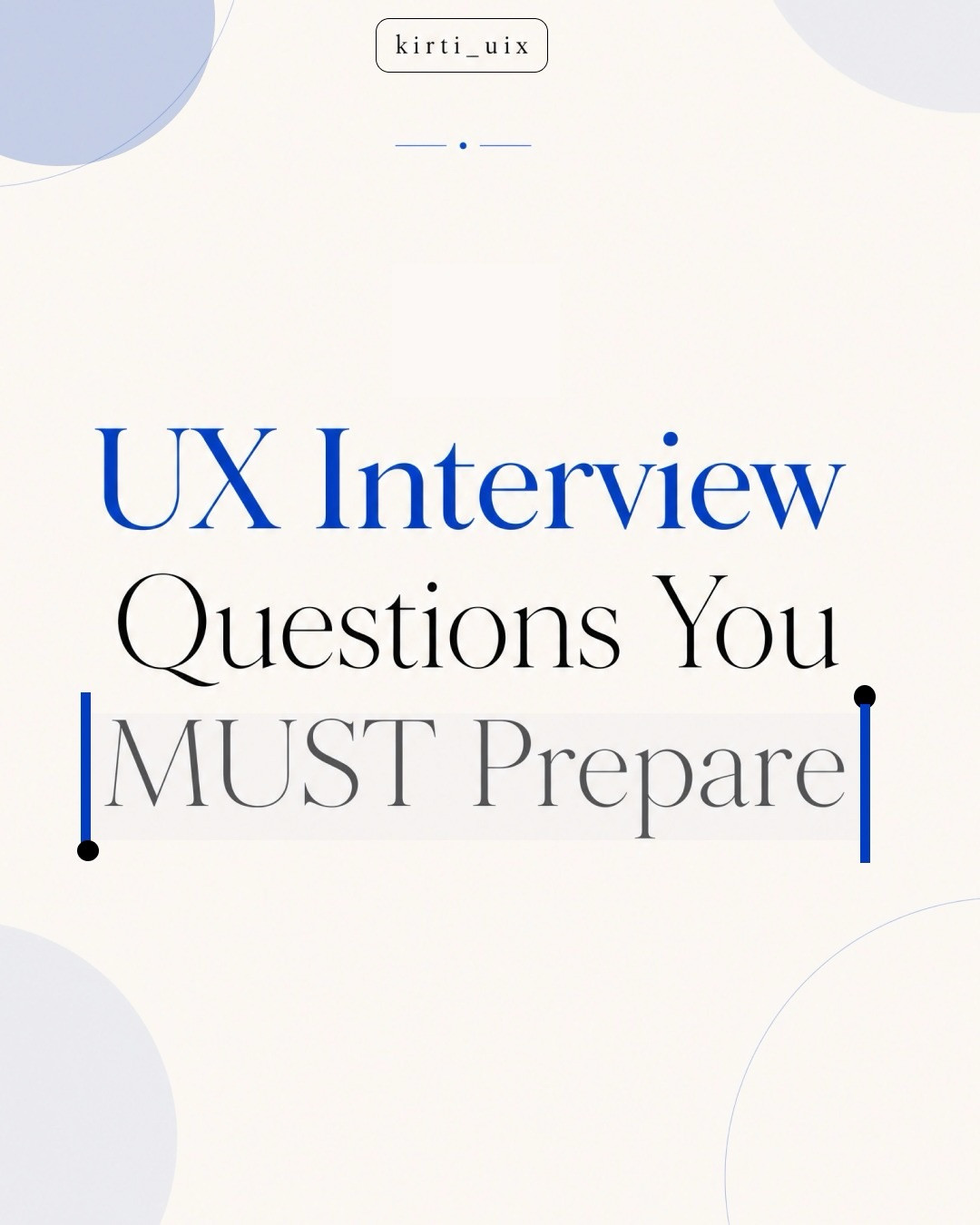
The Most Common UX Interview Questions (And How to Actually Answer Them)
Post by @kirti_uix, breaking down the UX interview questions that catch designers off guard.

UX interviews are weird. They're not just about your portfolio, they're about how you think, how you communicate, and how you handle pushback. You can have the best work in the room and still lose the job because you couldn't articulate your process.
The good news? The same questions come up over and over. Once you know them and have a framework for each, you can walk in with confidence.

"Tell Me About Your Design Process"
This is the opener. Everyone asks it. The mistake most designers make is describing a generic process, research, wireframe, prototype, test. That's a checklist, not a process.
Instead, walk through a real project. Start with the problem, explain how you researched it (specifically, what methods, what you learned), how that informed your design decisions, and what the outcome was. The interviewer wants to see your thinking, not your knowledge of Design Thinking 101.
Framework: Problem → Research → Key Insight → Design Decision → Outcome

"How Do You Handle Disagreement With a Developer?"
This question is really asking: are you going to be difficult to work with?
The wrong answer is "I fight for my design." The right answer shows collaboration. Talk about a time when a developer pushed back, how you understood their constraints (technical, timeline, resource), and how you found a middle ground that preserved the core UX without blowing the scope.
Framework: Their concern → Your constraint analysis → Compromise → What you learned

"Walk Me Through a Project You're Not Proud Of"
This is the trap question. They want to see if you can be honest, take responsibility, and learn from mistakes.
Pick a real project that didn't go well. Not a fake humble brag like "I cared too much." An actual miss, maybe you skipped user testing and the design failed in production, or you overdesigned a feature that users found confusing.
Own it. Explain what you'd do differently. Show that you've already applied that lesson to subsequent work.
Framework: The project → What went wrong → Why it happened → What you changed going forward

"How Do You Measure the Success of Your Design?"
This separates designers from pixel-pushers. If your answer is "it looked good and the client liked it," you're in trouble.
Talk about metrics that matter: task completion rate, time-on-task, error rate, conversion rate, NPS, retention. Explain how you set up tracking before launch, what you measured after, and how that data informed the next iteration.
If you don't have hard numbers (many designers don't), talk about how you'd set up measurement, what you'd track, why, and what decisions you'd make based on the data.
Framework: Metric → Baseline → Post-launch result → Decision driven by data

"What's the Difference Between UI and UX?"
Yes, they still ask this. And yes, you need a good answer that isn't a textbook definition.
UX is the strategy, research, information architecture, user flows, testing. UI is the execution, visual design, interaction design, micro-interactions. But the real answer is that they're inseparable. A beautiful interface that's hard to navigate is bad UX. A well-structured flow that looks terrible is bad UI. The best designers blur the line.

Preparation Is the Interview
The designers who get offers aren't the ones with the best portfolios, they're the ones who practiced their answers. Run through these questions out loud. Time yourself. Get comfortable talking about your work like a story, not a list of tasks.
And if you're building your portfolio to land that interview, Base44 lets you create real, working apps without code, so your portfolio can show live products, not just screenshots.
Originally posted by @kirti_uix on Instagram.
Related on NewForm
Keep reading
Find Your Stack
Discover the perfect design tools for your workflow.
Take the 60-second quizNewForm Studio
Turn your designs into professional mockups instantly.
Open StudioMore from NewForm

15 UX Portfolio Examples That Get Designers Hired (And What Each One Does Right)
Fifteen real UX portfolio examples from working designers, the one lesson each teaches, a structure checklist, and how to build yours in a weekend.
11 min read · Nov 1, 2026
How to Choose UI Fonts by Mood: A Practical Pairing Method
Turn mood words like elegant, bold, and editorial into a practical type pairing, then test it on real interface content.
4 min read · Oct 21, 2026